

The following paragraphs describe what happens to break rock when the piston strikes the tool.
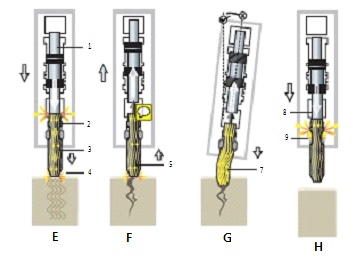
(A)Contact-Initial
Compression Stress Wave
When the piston (1) strikes the top of the tool (2), it sends a compressive stress wave (3) down to the working end of the tool. If the tool is touching a rock, this energy/force (compressive stress wave) travels out the tool directly into the rock
(4), fracturing it.
(B) Recoil-Reflected
Stress Wave
Immediately following the initial compressive stress wave, a
reflected stress wave is formed (5), which travels back up the tool, `bouncing` the piston up off the top of the tool. This cycle of compressive and tensile stresses flowing up and down the
tool is repeated with each piston blow (E&F).
(C) Bending
Anything interfering with the strength of the compressive stress waves (7) during operation such as blank-firing (free-running) or prying with the tool, can lower breaker performance and cause tool fatigue.
The breaker must be at a 90° angle to the face of the rock.
(D)Blank-firing
Blank-firing the breaker without the tool pressing on a rock causes the energy that normally travels out
the tool into the rock (8), to impact the retainer pins (9) and front head
causing excess stress to these components.