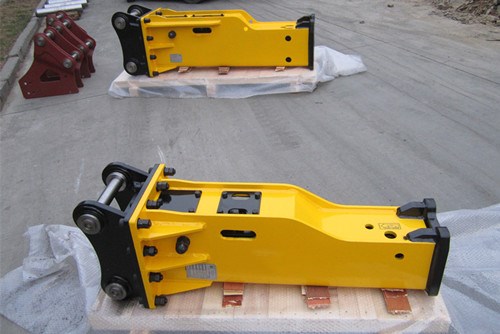
Hydraulic breaker: How to choose, types and
functions
The Hydraulic breaker is par excellence one of the most powerful and versatile
tools that are widely used in the construction industry for demolition and
excavation work. Also, if used with the proper training and necessary safety
precautions, they can be very useful tools in completing construction projects
efficiently and effectively.
If you are thinking of renting or buying a hydraulic breaker, you have to read
this article until the end. Everything you need to know you will find here.
What are Hydraulic breakers?
They are tools used in construction and demolition to break hard surfaces such
as concrete and rock, which work by applying hydraulic pressure to a piston
that strikes a tip or chisel on the desired surface. They are also used in
mining and oil and gas exploration.
Plus, these powerful tools come in a variety of sizes and shapes, from small
for precision work to large for heavy-duty demolition work. For this reason,
learn about the different types of hydraulic breakers below.
Types of Hydraulic breakers:
There are several types, and each one is designed for specific tasks. Some of
the most common types are:
Small Hydraulic Breakers: These breakers are ideal for precision demolition
work in tight spaces and hard-to-reach areas.
Medium-Size Hydraulic breakers: These hammers are ideal for demolition work in
small to medium commercial and residential construction.
Large Hydraulic Breakers: These breakers are ideal for demolition work on
commercial construction and large structures.
Hydraulic breakers for excavators: These breakers are designed to be attached
to excavators and are ideal for demolition and excavation work.
High Pressure Hydraulic breakers: These hammers are ideal for demolition work
on hard surfaces such as granite and rock.
Hydraulic hammer for underwater work: These hammers are ideal for underwater
repair and demolition work, such as repairing piers and bridges.
In general, the choice of tool depends on the type of work being done and the
surface being worked on. Selecting the right hammer is important to ensure safe
and effective demolition.
So, what criteria should I take into account when choosing a hydraulic breaker?
Learn about the most important below:
How to choose a Hydraulic breaker?
Choosing the right tool depends on several factors, such as the type of work to
be carried out, the size and shape of the material to be demolished, and the
machinery with which the hammer will be used. Here are some important criteria
to consider when choosing it:
Size and capacity: The size and capacity of the tool must match the size and
capacity of the machine to be used. It's important to make sure the tool is big
enough to do the job, but not so big that the machine can't handle it.
Power: The power of the hydraulic breaker must be sufficient for the task to be
performed. It is important to consider the impact power, the frequency of blows
per minute and the recoil force.
Compatibility: The tool must be compatible with the machine to be used. It is
important to ensure that the tool can be easily attached to and detached from
the machine.
Durability: The durability of the tool is an important factor to consider. It
is important to choose a tool that is built with high-quality materials and is
designed to last.
Maintenance: It is important to choose a hydraulic breaker that is easy to
maintain and repair. The availability of spare parts and the ease of access to
the parts of the tool that require maintenance must be considered.
In summary, when choosing a hydraulic breaker, it is important to consider
size, capacity, power, compatibility, durability, and maintenance. Considering
these criteria will help ensure that the right part is selected for the task at
hand.
Likewise, we cannot ignore security measures during its use, so take note of
the following recommendations.
Safety recommendations for the use of a hydraulic breaker:
Using this tool can be dangerous if proper safety precautions are not taken.
Here are important recommendations to ensure safety during use:
Training: Only trained and authorized persons should operate a hydraulic
breaker. Training must include instructions on how to safely operate the tool
and how to perform proper maintenance.
Personal Protective Equipment: It is important to wear personal protective
equipment, including hard hat, safety glasses, gloves, and protective clothing,
while using the hydraulic breaker.
Pre-inspection: Before using the hydraulic breaker, a pre-inspection should be
carried out to make sure that all parts are in good condition and there is no
oil leakage.
Work area: The work area must be well lit and clear of obstacles. An exclusion
zone must be established to keep unauthorized persons away from the work area.
Proper Connection: The hydraulic breaker must be properly connected to the
machine and secured before use.
Proper use : The tool must be used only for the tasks for which it was
designed. It should not be used for other tasks or as a prying tool.
Proper Shutdown : The hydraulic breaker must be properly shut down after use
and before being unplugged.
Maintenance: The hydraulic breaker must be properly stabilized to ensure its
safety and effectiveness. The manufacturer's recommended maintenance schedule
should be followed.
To be specific, the safe use of the hydraulic breaker requires proper training,
personal protective equipment, prior inspection, clear work areas, proper use
and connections, proper shutdown, and preventative maintenance. Therefore, by
following these recommendations, you can ensure safe and effective use of this
powerful tool.
In Yantai Rocka Machinery Co., Ltd,we can provid ROCKA Hydraulic
Breaker,ROCKAGE Quick Hitch Coupler, ROCKAGE Hydraulic Compact,Excavator
Ripper,ROCKAGE Hydraulic Post Driver and Earth Auger,etc.