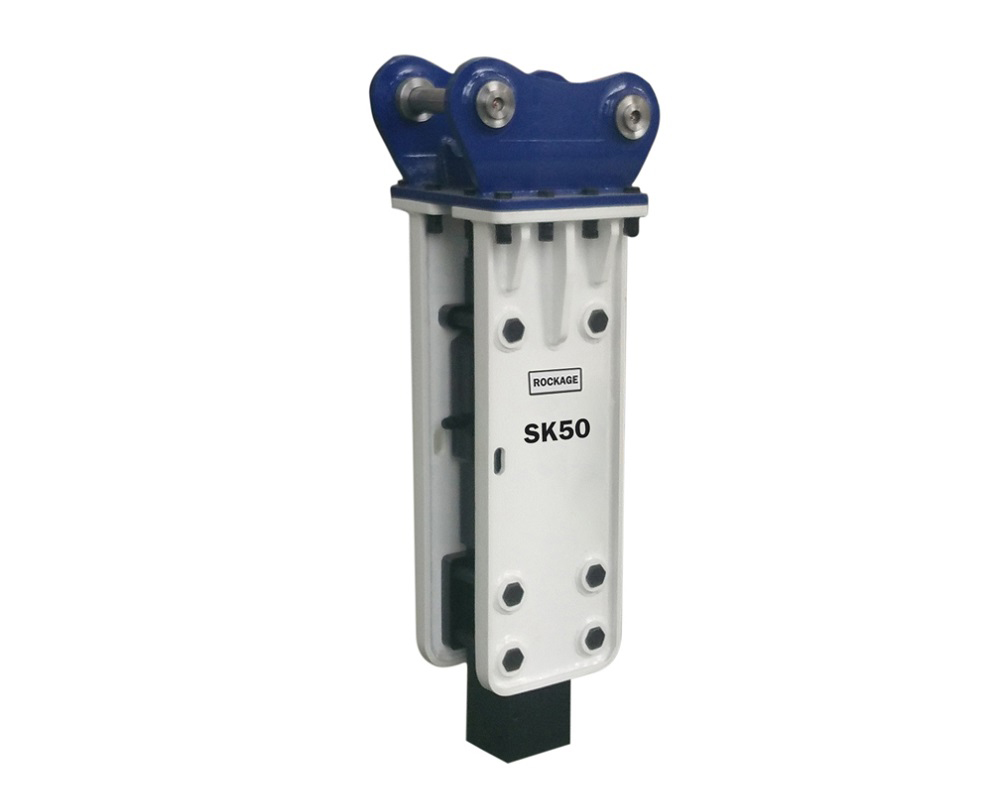
Excavators are one of the more adaptable pieces of equipment in this respect. In addition to the buckets used to scrape or dig into the earth, Hydraulic Compact,Excavator Ripper, Hydraulic Post Driver, Earth Auger and grapples can be attached for specific jobs. Like a Swiss Army knife, if there`s a job that needs to be done, the excavator probably has an attachment for it.
Hydraulic Hammer/Breaker
There are times when an obstacle prevents normal excavation from occurring. Used in mining, quarries, excavation, and demolition, the hammer/breaker is brought in to chip away at large boulders or existing concrete structures. There are times when blasting is used to remove obstacles or breakthrough thick layers of rock, but hammers offer a more controlled process.
Breakers are driven by a hydraulic piston that exerts pressure on the head of the attachment to provide a powerful and consistent thrust into the obstruction. In simplest terms, it`s just a really really big jackhammer. Great for tight spaces and continuous production, breakers are also much quieter and create less vibration than blasting.
Follow All Precautions
Still, these powerful tools still need to be handled with the care and safety of any industrial machine. An experienced operator and spotter working in tandem will reduce injuries or unwanted fissures during operation. Understanding how the machine works will also prolong the lifespan of the breaker/hammer.
Blank-firing is when there is no object or material to accept the force of the breaker. So the piston fires into the tool shank, but that energy can`t be absorbed by dead air. The shock is sent back up the tool and crashes into other shocks being sent down the tool.
That`s a lot of force meeting in the middle which will cause undue stress and wear on the tool itself. This is where experience comes into play. By anticipating the [break" of the obstacle, an operator can stop the breaker just before the intended piece falls away. This limits the number of blank fires, protecting the tool.
As with all machinery, the breaker should be inspected before and after every use to ensure good working conditions. Unusually worn components should be addressed and the operator needs to make sure the proper amount of lube or grease is being used. During operation, make sure the following processes are followed for safety. For the tool, the operator, and other personnel in the area, make sure to consult the OEM users manual for correct operation.
General Rules
- Only run a breaker or hammer from the operator`s seat to ensure maximum control
- Be aware of flying debris – use protective eyewear, make sure protective window or screen is available for operator
- When installing/removing attachment, be mindful of pinch points
- Make sure safety decals and signage are clean and legible
- Use the right size attachment for the job
Operational Precautions
- The breaker/hammer must only be used perpendicular to the object
- The use of the attachment should never lift the excavator off the ground
- The head should always be able to move freely
- Work from the edges of the obstruction, never the center
- When working in a trench, never allow the breaker to hit trench walls
For intended uses only
- Never hit the same spot for 15 seconds straight
- Never use the breaker/hammer attachment to lift something
- Never use the breaker/hammer to move a rock
- Never use the breaker/hammer as a pry bar
- Never submerge the breaker/hammer into the water at depths you can no longer see the tool
When to Stop Operation
- When hydraulic hoses begin to rattle violently – the energy chamber needs repair
- When the point, chisel or spade stops moving – the tool may have seized
- When hydraulic oil begins to leak – gaskets or other parts may be too worn for operation